When you look for therapy for your child, how do you know the system behind the service is working for you? In Colorado, that answer is getting clearer. State oversight now pushes providers, insurers, and Medicaid teams to keep records cleaner, supervision tighter, and communication more visible. For families exploring ABA therapy in Colorado, that shift can mean a process that feels more organized from the first call.
ABA includes assessment, treatment planning, direct sessions, parent training, progress review, and insurance coordination. When the state strengthens standards across those layers, families often get clearer updates and more consistency around what the child is working on and why.
The Shift in State Oversight Across ABA Therapy in Colorado
Colorado has moved toward stronger review systems that connect clinical quality with billing accuracy and family protections. That affects how providers document goals, supervise staff, submit claims, and explain service changes. The state is asking providers to show consistency through records and processes.
Medicaid Audits and Billing Reviews
Medicaid reviews now focus more closely on service logs, billing codes, session timing, and medical necessity. That encourages providers to connect each billed service to a documented need and a defined treatment target. For families, the benefit often appears in cleaner authorizations, fewer preventable claim issues, and care plans that match the approved service level.
When providers do that well, families seeking ABA therapy in Colorado move through a process that feels more stable and easier to follow.
Stricter Documentation and Provider Accountability
Documentation now carries more clinical weight. Good records show whether a child is moving toward functional goals, whether treatment hours match need, and whether supervision supports the direct therapy team. Colorado’s direction here pushes providers to keep records timely, specific, and tied to measurable outcomes.
That improves accountability at every level. BCBAs must keep plans current. Behavior technicians must reflect real targets in their notes. Administrative teams must keep files organized enough to support continuity when a payer or reviewer asks questions.
Rate Reviews and Funding Controls
Rate reviews and funding controls shape how public resources support therapy access. When the state reviews payment structure, providers usually respond by tightening staffing plans, protecting medically necessary hours, and improving scheduling discipline. That sounds administrative, but it affects families in practical ways.
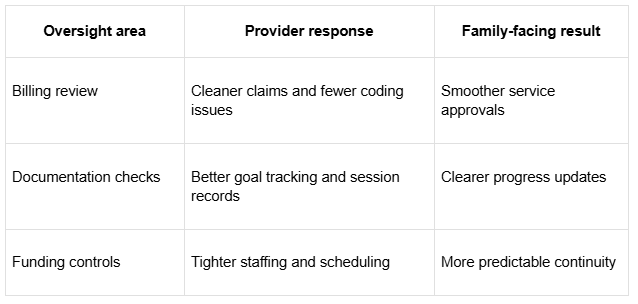
This is crucial because demand remains significant. Around 1 in 54 children in Colorado is identified with Autism Spectrum Disorder, which points to a large number of families who may seek developmental support and therapy services across the state.
Parent Rights and Grievance Transparency
Oversight also improves how providers explain parent rights, consent, service changes, and complaint pathways. Families should know who supervises the case, how goals are reviewed, and where to raise concerns if something needs attention. Clear communication helps parents stay informed.
What Tighter Oversight Means for Families Seeking Colorado ABA Services
For families, tighter oversight usually feels like a stronger structure. The benefit is not a rule on paper. The benefit is better discipline in daily care, cleaner coordination, and more reliable communication across the team.
Improved Session Reporting and Service Consistency
Better session reporting improves treatment quality. When providers document targets, prompts, responses, and next steps with precision, therapy becomes easier to adjust and explain. Parents can see where progress is happening and what still needs attention.
Good oversight also supports more dependable ABA therapy in Colorado for families who need stable care from week to week.
Safer Hiring and Supervision Standards
Families want to know who enters the home, who trains the staff, and who reviews the case. Stronger oversight improves those answers. Providers respond with tighter hiring checks, clearer role expectations, and more structured BCBA supervision.
That supports treatment integrity. A well-supervised team follows the plan with more consistency, uses the right teaching strategies, and raises questions earlier when a child needs adjustment.
Stronger Insurance Protections and Claim Accuracy
Insurance pressure can slow access when documentation is weak or when authorizations do not match the service delivered. Oversight helps by pushing providers to justify care clearly, align treatment hours with approved services, and keep supporting records ready when payers request them.
That reduces avoidable friction. It also gives parents a better view of what is covered, why hours were approved, and how ongoing care stays connected to ABA therapy in Colorado service goals.
How Ambitions ABA Aligns With Colorado’s Oversight Standards
Ambitions ABA offers ABA therapy services in Colorado, including in-home ABA therapy, center-based programs, personalized treatment plans, parent and family training, and support with insurance eligibility and approvals. Our team also provides in-home ABA therapy in Denver, giving families access to care in a familiar environment.
We also answer the issues families care about most. We reduce wait barriers, offer flexible service settings, support parent participation, and target real-life skills such as communication, self-care, routines, and social interaction.
Families also benefit from support during intake, help with insurance direction, and parent coaching that carries learning into meals, play, transitions, and home routines.
Long-Term Impact on ABA Therapy in Colorado Providers and Communities
The long-term effect of stronger oversight is a more mature service market. Providers that invest in training, documentation quality, supervision, and communication will build stronger operations over time. Families will compare providers on more than availability. They will look at reporting quality, therapist consistency, and how clearly a team explains progress.
Communities benefit as well. Schools, pediatricians, case managers, and families work better together when therapy providers use clear records and defined standards. That can support smoother referrals, better continuity, and stronger skill carryover across home, school, and community settings.
We believe that quality care should be clear and usable for families. That is why stronger oversight can support better service reach across Colorado when providers respond with discipline and care.
Conclusion
Colorado’s oversight direction is improving the service experience in meaningful ways. It is encouraging better records, better supervision, better claim accuracy, and clearer family communication. That is good for children, good for parents, and good for the future of ABA therapy in Colorado.
If you want a provider that values structured care, family partnership, and flexible support, contact Ambitions ABA today and let us help your family take the next step.
FAQs
Does Colorado require a formal autism diagnosis before ABA can begin?
Many payers require diagnostic documentation before they approve services, but the exact rule depends on the funding source and provider intake process.
How often should a BCBA review a child’s program?
Review frequency depends on clinical need, funding rules, and provider policy. In a strong program, BCBA oversight stays active.
Can ABA goals focus on school readiness, not only behavior reduction?
Yes. Many plans target communication, transitions, classroom participation, play, and independence skills.
What should parents bring to an ABA intake appointment?
Parents should bring diagnostic records, insurance details, school reports, prior evaluations, and a list of current concerns and goals.
Is in-home ABA a good fit for routine-based support?
Often, yes. In-home services can work well when goals involve meals, dressing, transitions, bedtime routines, or family communication.