

What Makes Denver In-Home ABA Therapy Effective for Autism Treatment
What changes when therapy happens in the place where your child eats, plays, learns, and communicates every day? That question sits at the center of why many families choose Denver in-home ABA therapy for autism treatment. The home gives clinicians direct access to routines, triggers, transitions, and skill opportunities that shape daily behavior. That setting makes teaching more relevant from the first session.
A child can practice requesting during snack time, following directions during cleanup, and building tolerance during real transitions. Parents also see the treatment process up close, which makes carryover stronger across the week. When the therapy plan matches the child’s environment, the learning process feels more natural, more stable, and more useful in day-to-day life.
Why Denver In-Home ABA Therapy Delivers Stronger Outcomes at Home
Home is where children show their natural patterns, responses, and communication habits most clearly. That makes it easier for therapy to stay relevant, consistent, and closely tied to the skills a child needs every day.
Therapy Inside Daily Routines and Natural Environments
Home-based treatment works because it teaches skills that will actually be used. A therapist can target communication during meals, cooperation during dressing, and waiting skills during preferred activities. That creates better generalization because the child does not need to relearn the behavior in a second setting later.
In many families, Denver in-home ABA therapy supports faster day-to-day use of goals because treatment happens inside familiar routines, with familiar people, and with real household expectations already in place.
Parent Participation and Skill Carryover Beyond Sessions
Children progress faster when parents know how to reinforce the same targets between sessions. A strong provider does not isolate therapy from family life. The therapist teaches the child and coaches the caregiver at the same time, so both sides move in one direction.
Parents often support carryover through:
- clear prompting language during meals or play
- simple reinforcement systems that fit the child’s routine
That type of alignment lifts consistency. It also turns therapy hours into a larger learning system that continues through the week.
Individualized Behavior Plans Based on Data Tracking
Effective ABA stays personal. The BCBA starts with assessment, baseline data, direct observation, and family input. From there, the team builds goals around communication, social engagement, self-help skills, attention, and functional behavior. Each target needs a measurement method, not a vague intention.
In Denver, in-home ABA therapy, that precision allows clinicians to adjust prompts, reinforcers, pacing, and task size based on performance trends. Families do not just hear that progress is happening. They can see it through data tied to meaningful daily outcomes.
Consistent Scheduling That Reduces Disruptions
Consistency supports learning because children respond well to predictable structure. In-home care often fits more smoothly into the family calendar, which helps sessions stay regular from week to week. That rhythm protects momentum. It also gives children a stable pattern of interaction with the therapist.
Over time, steady scheduling supports skill acquisition, stronger rapport, and more productive sessions. Families benefit too because treatment fits around school, meals, and home life without putting pressure on the rest of the day.
One-on-One Attention That Supports Communication Growth
Communication growth often depends on what happens in small moments. A one-on-one model lets the therapist respond right when the child makes eye contact, gestures, vocalizes, or attempts a request. Those moments matter because timing shapes learning.
In Denver, in-home ABA therapy clinicians can build language in natural exchanges with preferred toys, family members, and household routines. That gives the child repeated chances to practice communication with direct support, immediate reinforcement, and goals that connect to everyday interaction.
How Families Experience Greater Stability With Denver In-Home ABA Therapy
Families often do better when therapy fits into daily life instead of interrupting it. With Denver in-home ABA therapy, support can follow the child’s real schedule, reduce avoidable stress, and create a steadier rhythm for both parents and children.
Flexible Session Planning Around School and Family Life
A family-centered program should fit the home, not compete with it. Session timing needs to reflect school demands, energy levels, meals, sibling schedules, and rest. That flexibility protects both attendance and treatment quality.
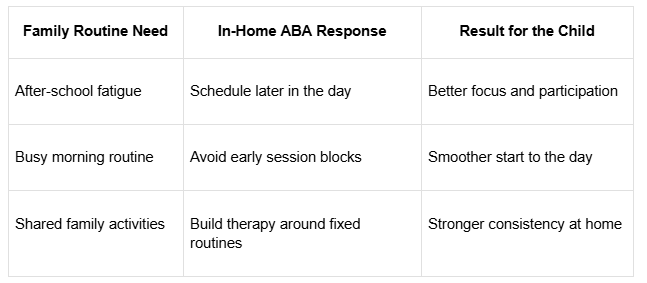
When planning respects the family calendar, the child enters sessions with better readiness, and the household stays more settled.
Reduced Travel Burden for Parents and Children
Travel takes time, planning, and emotional energy. Home-based autism therapy keeps that energy available for treatment and family life. Parents can stay close to sessions, observe more easily, and ask better questions in real time. Children also stay in a familiar environment, which can support attention and smoother participation. That convenience does more than save time. It keeps therapy connected to the pace of the household and allows treatment to work with the family’s day.
Progress Measured Through Ongoing Behavior Analysis
Strong treatment depends on ongoing review. Clinicians should track prompt levels, frequency, duration, accuracy, and independence according to the child’s goals. That process shows whether a target needs expansion, simplification, or a different teaching method. It also protects treatment quality over time.
Colorado’s autism prevalence in the Denver metro area, including Adams, Arapahoe, Boulder, Broomfield, Denver, Douglas, and Jefferson counties, stood at about 1 in 50 children, or roughly 20 per 1,000 eight-year-olds, based on previous Colorado ADDM Project estimates. That number helps explain why structured, measurable home-based support remains so relevant for many families across the region.
How Ambitions Supports In-Home ABA Services in Denver
Ambitions ABA focus on personalized treatment that fits real routines, family goals, and measurable developmental progress.
Our services include:
- at-home ABA care with BCBA-led planning and data-based goals
- support with insurance steps, intake, and family guidance
- flexible service options across home, school, and community-based settings
We also build parent participation into the therapy process so families can reinforce communication, behavior, and daily living goals beyond scheduled sessions. That matters because progress becomes stronger when learning continues across the week.
We also serve families across multiple states, which reflects an established in-home therapy network with broad operational support. For Denver families, that means local access paired with a structured service model that values consistency, access, and clinical quality.
Conclusion
Effective autism treatment does not come from intensity alone. It comes from fit, repetition, structure, and relevance to daily life. Home-based ABA stands out because it teaches skills in the exact setting where children use them, while keeping parents involved in the process from one session to the next. That combination supports stronger carryover, smoother routines, and clearer progress tracking.
For families who want a therapy model built around daily function and measurable growth, Denver in home ABA therapy remains a strong choice. Contact Ambitions ABA today and let us help your family move forward with care.
FAQs
How soon can a child start in-home ABA after an initial evaluation?
That usually depends on insurance approval, intake paperwork, and when a therapist is available. Some families can begin fairly soon, while others may need to wait a little for scheduling to open.
What age groups benefit most from home-based ABA?
Home-based ABA can work well for children of different ages, not just very young kids. The goals change with age, from early communication and routines to independence and social growth.
Can in-home ABA include community goals outside the house?
Yes, it can, if those goals make sense for the child’s plan and current stage of progress. Some children work on outings, waiting, transitions, or communication in places beyond the home.
What should parents look for in an ABA provider in Denver?
Parents usually want a provider with BCBA oversight, clear goals, and steady family communication. It also helps when the team can fit therapy into the child’s real routine instead of forcing a set formula.
How do therapists choose which behaviors or skills to target first?
They usually start with skills that can make daily life easier and more manageable for the child. That may include communication, following directions, self-help tasks, or reducing behaviors that interfere with learning.